Paper: “Menopause representations as predictors of health and well-being during menopause: A comparison study of autistic and non-autistic people"
This paper was published in 2026, in the journal Autism in Adulthood.
The authors were Ms Eunhee Kim, Dr Rachel Moseley, Ms Racheal Stewart, Mrs Deborah Watts, and Professor Julie Gamble-Turner (author links will open in separate tabs where available).
This research was conducted as part of a PhD by Ms. Eunhee Kim, which was very kindly funded by Henpicked/Menopause in the Workplace. A PhD is like three years of training, where the PhD student conducts several research studies under the supervision of experienced researchers (in this case, me and Professor Gamble-Turner). Through this, they gain the experience to become an independent researcher themselves.
You can click HERE to download this paper.
Keep reading to see a less-detailed plain English summary, or you can watch my explanatory video. Please note the page looks better on a computer/tablet than on a phone - sorry about this!

Ms. Eunhee Kim
Why is this an important issue?
Menopause is a biological transition which affects people who menstruate, including cisgender women, trans men and some intersex people. Although our early research suggested that some autistic people find menopause very challenging, everyone is different – some autistic people find menopause relatively easy, while some non-autistic people can struggle.
Understanding why some people really struggle at menopause could help us identify people at risk before they go into menopause. Understanding the factors that make menopause more difficult for some people may also highlight ways we could intervene to help.
Here is a video summary of this paper. You can change your view by clicking on the symbol in the right-top corner. You can also open it up to large screen, and turn captions on and off by clicking the 'CC' button. (Please ignore my speech impediment in places!)
When we talk about “menopause”, we are talking about the whole of this transition. That includes what is known as peri-menopause (the time before a person ‘reaches’ or ‘passes’ menopause), the time when they ‘reach’ or ‘pass’ menopause (i.e. have had 12 months in a row without a period), and the time when they are post-menopausal but still experiencing menopause symptoms.
What was the purpose of this study, and what did the researchers do?
Together with Eunhee, we wanted to compare autistic and non-autistic people’s experiences of menopause at a bigger scale than our previous studies, and see how menopause symptoms changed or fluctuated over a short period of time. We also wanted to try to understand some of the reasons why some people might report more severe menopause symptoms than others.
Eunhee designed an online survey with help from her supervisors and an autistic advisory panel, who guided our decisions around the psychological questionnaires included in the survey. Our participants were 476 autistic and 425 non-autistic people, who were either going through peri-menopause or were post-menopausal. We asked about their menopause symptoms. We also asked many questions about their health, characteristics and life experiences, so that we could explore possible factors that might explain why some people self-reported more severe menopause symptoms.
After our participants completed this long survey, some kindly agreed to complete four short follow-up surveys over the next four weeks, so that we could look at how their menopause symptoms and their wellbeing changed over time.
Eunhee gathered so much data that we will write several papers together, looking at different possible reasons for difficulties during menopause. In this first paper, we focused on menopause representations.
What are menopause representations?
“Representations” are the ideas, beliefs, feelings and expectations that a person holds about any given topic, based on their experience with that topic or what they’ve heard about it. Menopause representations are therefore ideas, beliefs or expectations that people hold about menopause.

In our previous research, we noticed that some autistic people thought about menopause as “a sub-optimal state of illness”, whereas some others thought about it as “just a natural part of ageing”. People differ in their menopause representations – for instance, some people believe that they can do things to improve their symptoms , whereas others think that they are powerless to influence their symptoms. Some people perceive menopause as a major change in who they are as a person, whereas others see it as just a biological marker with little significance.
Menopause representations are important because the way you think about your menopause affects the way you experience it. For example, people who think they have no control over the severity of their symptoms tend to experience their symptoms as more distressing. The relationship probably goes two ways: if a person thinks they have no control over their symptoms and experiences them as highly distressing, they will likely feel even more out of control and more distressed. This could then become a vicious circle.

Really importantly, a person’s menopause representations (i.e., the way they think about menopause) is not their fault. Their representations are influenced by their life experiences, broader health and innate characteristics. For instance, if you have suffered traumatic healthcare encounters related to gynaecological issues, you might perceive menopause as very threatening. If you have an illness which affects your menopause, or if you are an anxious person, you might be less likely to feel in control of your menopause symptoms.
A person is not responsible for their menopause representations, or the way they experience their menopause.
Moreover, even if the way a person thinks and feels about menopause has some impact on how they experience it, this does not mean that their symptoms are 'all in their mind'. This is absolutely not true - menopause symptoms are biologically very real.
The reason we are interested in menopause representations is because it gives professionals another avenue where they can intervene to help people. For instance, if we see that feeling out of control can heighten people’s distress during menopause, there might be ways we can help them feel more control over their symptoms and their lives.
What were the results of this study?
Across five weeks, autistic people consistently reported more severe menopause symptoms than non-autistic people. Their menopause symptoms did not fluctuate more than we saw in non-autistic people.
Autistic people also reported more severe depression and anxiety symptoms, poorer quality of life, and worse physical health. For example, they were more than two times likelier to have a cardiovascular, respiratory, gastrointestinal or musculoskeletal illness.
Menopause symptoms were linked to poorer mental health and quality of life. That means people who self-reported more severe menopause symptoms tended to have greater anxiety and depression, and worse quality of life.
When we looked at autistic people’s menopause representations, we found that autistic people tended to feel a lower sense of control over their menopause symptoms. They also reported having a lower sense of coherence about their menopause symptoms. This doesn’t mean that autistic people knew less about menopause – rather, it means that it was harder for them to make sense of their symptoms (i.e., to recognise that these symptoms were because of menopause). This makes sense: if autistic people tend to experience menopause differently to non-autistic people, then publicly available descriptions of menopause might be less relevant to them, making it harder to understand the changes to their bodies and minds.
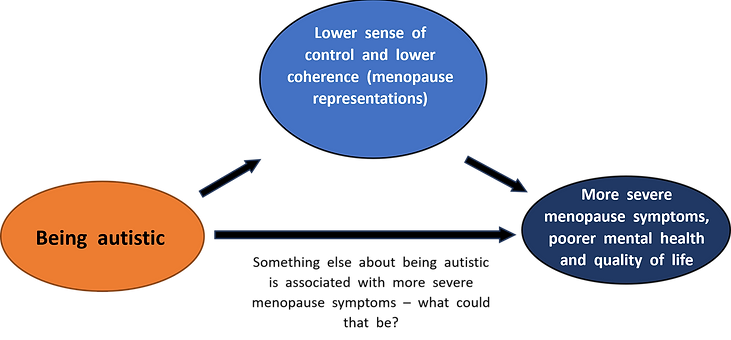
We found that feeling less in control and having a less coherent understanding of your menopause partially explained relationships between being autistic and reporting more severe menopause symptoms. That means:
a) being autistic is associated with feeling less in control and less coherent about menopause.
b) feeling less in control and less coherent about menopause leads people to report more severe menopause symptoms, as well as poorer mental health and quality of life.
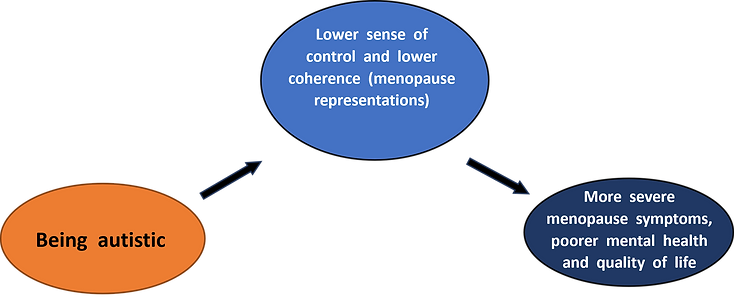
However, we also saw that aside from feelings of control and coherence (menopause representations), being autistic was associated with reporting more severe menopause symptoms in its own right.
That means something else about being autistic was linked to reporting more severe menopause symptoms. For example, perhaps the sensory sensitivities experienced by autistic people explain why they report greater difficulties during menopause. This is just one of many other explanations which we will explore in our next papers.
What are potential weaknesses in the study?
Our study had a very short follow-up period (5 weeks). We might not have observed menopause symptom fluctuations that happen over a longer time frame.
Although we looked at menopause representations as a factor which might explain why some people report more severe menopause symptoms, this relationship is likely to be two-way. That is, our participants might be experiencing lower feelings of control and lower coherence about their menopause symptoms because their symptoms are more extreme. We cannot tell. We need to explore other factors that might explain more severe self-reported menopause symptoms in autistic people.
We used measures that weren’t validated in autistic people. That means that our measures might not be picking up exactly what we thought.
Finally, our autistic sample is not representative of all autistic people. Very few of our participants had minority gender, sexual, ethnic and/or racial identities, meaning that our findings might not apply to all autistic people. Our study was not accessible to autistic people with learning disabilities, so our findings might not apply to them.
Thank you for reading!
How will these findings help autistic adults now or in the future?
Our study is one of the first to go beyond simply saying that autistic people can have more severe menopause symptoms. We started to explore why this might be. Identifying the reasons why some people struggle during menopause is extremely important – we can only find effective ways to help when we understand a problem.
Our findings suggest that feeling more in control, and having a better understanding of what’s happening to you, are important for well-being during menopause. We need to dig deeper into why autistic people tend to feel less in control during menopause, and why they have a lower sense of coherence around what is happening to them.
Looking at how people think and feel about menopause (their menopause representations) does not mean it is the individual’s responsibility to change how they think and feel. For example, autistic people might feel a lower sense of coherence and less in control because they do not have equal access to information and healthcare. This highlights the need to give autistic people better information and support before and during the menopausal transition.
However, our findings also highlighted that there are other reasons why being autistic might put people at risk of experiencing more severe menopause symptoms. We will explore a range of characteristics and experiences to understand other reasons why some people have more severe symptoms during menopause. We hope this will help us find multiple ways to intervene.
If you found this interesting, you may like to read:
You can also read non-academic articles and watch some talks on autistic menopause under Media and Online Publications.
Sadly there aren't many resources we know of for the menopause. But there are a few on the resources page!